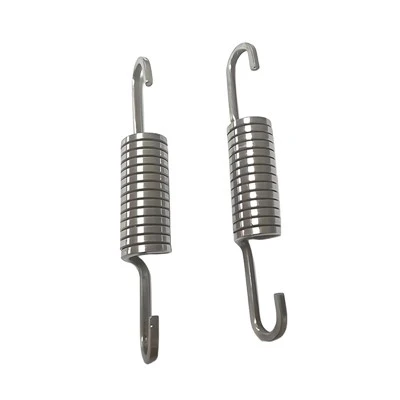
Hey there! As a supplier of Nested Wave Springs, I often get asked about how to calculate the energy storage capacity of these nifty little components. So, I thought I'd share some insights on this topic in this blog post.
First off, let's understand what a Nested Wave Spring is. A Nested Wave Spring is a type of spring that consists of multiple waves stacked on top of each other. It's a compact and efficient solution for applications where space is limited but a high load capacity is required. You can learn more about them on our Nested Wave Spring page.
Why is Energy Storage Capacity Important?
The energy storage capacity of a spring is crucial because it determines how much energy the spring can absorb and release. In many applications, such as automotive engines, aerospace components, and industrial machinery, the spring needs to store and release energy to perform its function effectively. For example, in a valve spring, the energy storage capacity affects the valve's opening and closing performance.
Factors Affecting Energy Storage Capacity
Several factors influence the energy storage capacity of a Nested Wave Spring. Let's take a look at them one by one.
Material Properties
The material of the spring plays a significant role in its energy storage capacity. Different materials have different elastic moduli and yield strengths. For instance, high - strength alloys like stainless steel or chrome vanadium can store more energy compared to mild steel. The elastic modulus (E) is a measure of a material's stiffness. A higher elastic modulus means the spring can withstand more stress before it deforms permanently.
Number of Waves
The number of waves in a Nested Wave Spring affects its energy storage capacity. More waves generally mean more surface area for deformation, which allows the spring to store more energy. However, there's a limit to how many waves you can add, as it also affects the spring's overall height and load - deflection characteristics.
Wire Diameter
The wire diameter of the spring is another important factor. A thicker wire can withstand higher loads and store more energy. But, increasing the wire diameter also increases the spring's size and weight, which might not be suitable for all applications.
Outer and Inner Diameters
The outer and inner diameters of the Nested Wave Spring influence its energy storage capacity. A larger outer diameter and a smaller inner diameter can provide more space for the waves to deform, thus increasing the energy storage capacity.
Calculating the Energy Storage Capacity
Now, let's get into the nitty - gritty of calculating the energy storage capacity. The energy stored in a spring (U) can be calculated using the following formula:
[U=\frac{1}{2}F\delta]
where (F) is the force applied to the spring and (\delta) is the deflection of the spring.
To find the force (F), we can use Hooke's Law, which states that (F = k\delta), where (k) is the spring constant. The spring constant of a Nested Wave Spring can be calculated using the following empirical formula:
[k=\frac{Ed^4n}{8D^3m}]


where (E) is the elastic modulus of the material, (d) is the wire diameter, (n) is the number of active coils, (D) is the mean diameter of the spring ((D=\frac{D_{outer} + D_{inner}}{2})), and (m) is the number of nested layers.
Once we have the spring constant (k), we can find the force (F) for a given deflection (\delta). Then, we can calculate the energy stored in the spring using the formula (U=\frac{1}{2}F\delta).
Let's take an example. Suppose we have a Nested Wave Spring made of stainless steel with an elastic modulus (E = 193\times10^9\ Pa), a wire diameter (d = 2\ mm=0.002\ m), the number of active coils (n = 5), the mean diameter (D = 20\ mm = 0.02\ m), and the number of nested layers (m = 3).
First, we calculate the spring constant (k):
[k=\frac{193\times10^9\times(0.002)^4\times5}{8\times(0.02)^3\times3}]
[k=\frac{193\times10^9\times1.6\times10^{-11}\times5}{8\times8\times10^{-6}\times3}]
[k=\frac{193\times1.6\times5\times10^{-2}}{192\times10^{-6}}]
[k=\frac{15.44}{192\times10^{-6}}\approx80416.67\ N/m]
If the spring is deflected by (\delta = 0.01\ m), then the force (F=k\delta=80416.67\times0.01 = 804.17\ N)
The energy stored in the spring (U=\frac{1}{2}F\delta=\frac{1}{2}\times804.17\times0.01 = 4.02\ J)
Other Types of Wave Springs
Before we wrap up, I'd like to mention some other types of wave springs. We also offer Wavy Spring, Heavy Duty Wave Spring, and Linear Wave Spring. Each type has its own unique characteristics and applications, so make sure to check them out if you're looking for different spring solutions.
Contact Us for Your Nested Wave Spring Needs
If you're in the market for Nested Wave Springs or have any questions about calculating their energy storage capacity, don't hesitate to reach out. We're here to help you find the perfect spring for your application. Whether you need a custom - designed spring or a standard off - the - shelf product, we've got you covered.
References
- Shigley, J. E., & Mischke, C. R. (2001). Mechanical Engineering Design. McGraw - Hill.
- Budynas, R. G., & Nisbett, J. K. (2011). Shigley's Mechanical Engineering Design. McGraw - Hill.