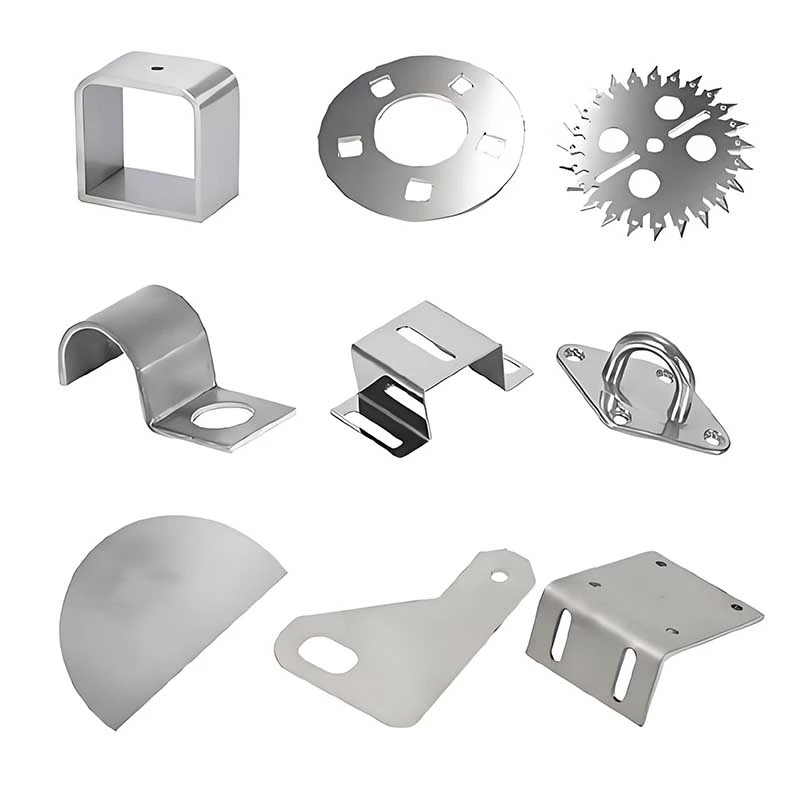
Stamped parts are components obtained by stamping metal sheets under die pressure, falling under the category of metal plastic forming. The main processing steps include blanking, fine blanking, drawing, and bending. The processability directly affects material consumption and die life, requiring optimization through geometry and dimensional accuracy. Blanked parts must avoid sharp angles, with an economical accuracy not exceeding IT11; fine blanking parts utilize precision blanking technology, with a typical surface finish of Ra0.8-1.6μm; bending parts have dimensional tolerances of FT5-FT10, influenced by die structure and material properties; drawing parts require controlled corner radii and prioritize bottom datum marking.
Stamped parts are widely used in the automotive manufacturing industry, with up to 1500 components per vehicle, covering body panels, structural parts, battery boxes, and other components. In the traditional model, the value of stamped and welded parts per vehicle exceeds 10,000 yuan, and the stamping market is projected to reach 216.3 billion yuan by 2025. Some companies have expanded their product portfolio by developing their own molds and matching them with assemblies, and have developed more than 3,000 kinds of stamped parts, including longitudinal beams, wheel covers, and door and window frames.